
Comparing Air Quality Targets Around the World - Part 1: PM2.5 and PM10
Air quality targets around the world are used to define what "clean air" means, but a building that passes one standard can be ten times less stringent than another standard.
This comparison looks at air quality targets from 16 government standards and building certifications from North America, Europe, and Asia-Pacific to show where they agree and where they diverge.
About This Series
This article is Part 1 of 4 in the Air Quality Target Comparison Series. We are splitting the full master comparison into four focused articles for readability:
Part 1 — Particulate Matter: PM2.5 & PM10
Part 2 — Carbon Gases: CO2 + CO
Part 3 — Organic Chemicals: TVOC + Formaldehyde
Part 4 — Inorganic Gases & Radon: Ozone, Nitrogen Dioxide, Sulfur Dioxide, and Radon
Standards referenced in this series (16 total): WHO 2021, EPA NAAQS, EU Directive 2024/2881, Singapore SS 554 (2021), China GB/T 18883, RESET Air v2.0, LEED v5 O+M, WELL v2, Fitwel, Living Building Challenge (LBC), ASHRAE 62.1 (2022), DGNB, BOMA BEST, Singapore Green Mark, HKGBC BEAM Plus, and China Green Building Standard.
How to read this comparison
Averaging periods matter. Different standards use different averaging periods, and concentration limits should therefore be interpreted together with their corresponding exposure durations. In this report, Annual limits are presented separately, while Daily, Short-term, and Unspecified limits are grouped together to improve readability and reduce the number of charts. It is important to note that Short-term and Unspecified does not indicate equivalence to Daily; it indicates that the standard uses different compliance approach or does not explicitly define an averaging period.
Short: Short-term peak exposure (15m, 30m, 1h)
Daily: Workday or daily exposure (4h, 8h, 24h)
Annual: Long-term chronic exposure
Unspecified: The standard does not define an averaging period for the reported limit
Type: Each standard is marked as Government (national codes, regulations, guidelines) or Certification (voluntary building certification or private framework).
Particulate Matter: PM2.5 and PM10
What they are: Particulate matter is just microscopic debris floating in the air. PM10 covers inhalable stuff like dust, pollen, and mold. PM2.5 refers to much smaller particles, mostly soot and emissions from engines, factories, and fires, that hang around in the air longer and travel much farther.
Why they are dangerous: Bigger particles mostly irritate your eyes and nose, but PM2.5 is small enough to bypass your body’s natural defenses. It pulls deep into your lungs and passes directly into your bloodstream, driving up the risk of heart disease, strokes, severe asthma, and lung cancer.
The death toll: It's a massive global health issue. Major health organizations estimate that fine particulate matter causes over 4 million premature deaths every year, making it one of the top environmental causes of early death.
Indoor air isn't a safe haven: Outdoor pollution is obvious, but indoor sources, like cooking, burning candles, or using wood stoves, often make indoor air just as bad.
Shutting windows isn't enough: Simply keeping your home shut tight during a wildfire or high-smog day won't keep PM2.5 out completely. Because these particles are so fine, they easily seep in through vents, window seams, and tiny gaps in doors, meaning you need active filtration (like a HEPA air purifier) to actually clean the air inside.
PM2.5 (Daily & Short-term & Unspecified)
Summary
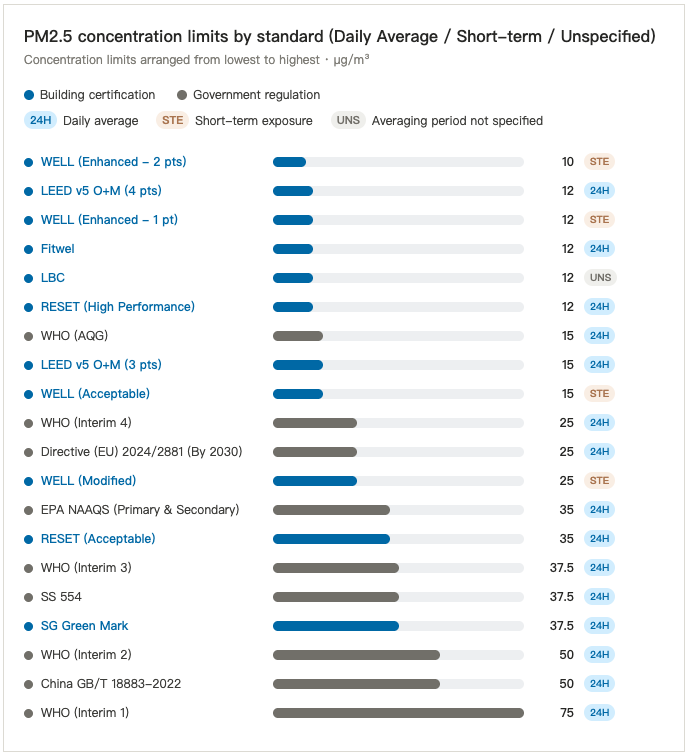
Range: 10 to 75 µg/m³, a 7.5-fold gap, across 20 limits. This is the densest comparison in the dataset.
Strictest: WELL Enhanced (2 pts) at 10 µg/m³, followed by RESET (High Performance), LEED v5 O+M (4 pts), Fitwel, and LBC at 12 µg/m³.
Most common value: 12 µg/m³, where five certifications converge: LEED v5 O+M (4 pts, 24H), WELL Enhanced 1 pt (STE), Fitwel (24H), LBC (UNS), and RESET High Performance (24H).
WHO alignment point: WHO AQG at 15 µg/m³ (24H, Government) aligns with LEED v5 O+M (3 pts) and WELL Acceptable, showing where certifications meet the WHO guideline.
Mid-range progression: Steps through WHO Interim 4 and EU Directive 2024/2881 (By 2030) at 25 µg/m³ (24H), RESET Acceptable and EPA NAAQS at 35 µg/m³ (24H), and WHO Interim 3 SS 554 SG Green Mark at 37.5 µg/m³ (24H).
Upper end: WHO Interim 2 and China GB/T 18883-2022 at 50 µg/m³ (24H) and WHO Interim 1 at 75 µg/m³ (24H).
Type split: Certifications dominate the low end (10-15 µg/m³), Government standards define the full progression from 15 to 75 µg/m³.
| Standard | Limit | Averaging | Type |
|---|---|---|---|
| WELL (Enhanced - 2 pts) | 10 µg/m³ | STE | Certification |
| LEED (4 pts) | 12 µg/m³ | 24H | Certification |
| WELL (Enhanced - 1 pt) | 12 µg/m³ | STE | Certification |
| Fitwel | 12 µg/m³ | 24H | Certification |
| LBC | 12 µg/m³ | UNS | Certification |
| RESET (High Performance) | 12 µg/m³ | 24H | Certification |
| LEED v5 O+M (3 pts) | 15 µg/m³ | 24H | Certification |
| WELL (Acceptable) | 15 µg/m³ | STE | Certification |
| WHO (AQG) | 15 µg/m³ | 24H | Government |
| WHO (Interim Target 4) | 25 µg/m³ | 24H | Government |
| WELL (Modified) | 25 µg/m³ | STE | Certification |
| Directive (EU) 2024/2881 (By 2030) | 25 µg/m³ | 24H | Government |
| RESET (Acceptable) | 35 µg/m³ | 24H | Certification |
| EPA NAAQS (Primary & Secondary) | 35 µg/m³ | 24H | Government |
| WHO (Interim Target 3) | 37.5 µg/m³ | 24H | Government |
| SS 554 | 37.5 µg/m³ | 24H | Government |
| SG Green Mark | 37.5 µg/m³ | 24H | Certification |
| WHO (Interim Target 2) | 50 µg/m³ | 24H | Government |
| China GB/T 18883-2022 | 50 µg/m³ | 24H | Government |
| WHO (Interim Target 1) | 75 µg/m³ | 24H | Government |
PM2.5 (Annual)
Summary
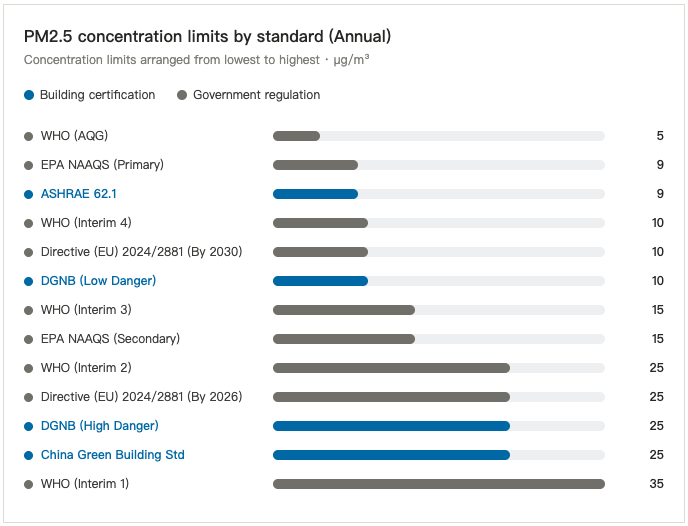
Range: 5 to 35 µg/m³, a 7-fold gap, across 13 limits.
Strictest: WHO AQG at 5 µg/m³ (Annual, Government).
Most common value: 10 µg/m³ and 25 µg/m³, each with three standards. At 10 µg/m³: WHO Interim 4 (Government), Directive (EU) 2024/2881 By 2030 (Government), and DGNB Low Danger (Certification). At 25 µg/m³: WHO Interim 2 (Government), Directive By 2026 (Government), DGNB High Danger (Certification), and China Green Building Std (Certification) — four at 25.
Mid-range progression: Steps through EPA NAAQS Primary and ASHRAE 62.1 at 9 µg/m³ (Annual), 10 µg/m³ cluster, then WHO Interim 3 and EPA NAAQS Secondary at 15 µg/m³ (Annual).
Upper end: WHO Interim 1 at 35 µg/m³ (Annual, Government).
Type split: Government defines the WHO ladder (5 to 35 µg/m³) and EU 2030/2026 targets (10 and 25 µg/m³) and both EPA NAAQS levels. Certifications mark low/high danger at 10 and 25 µg/m³ (DGNB), 9 µg/m³ (ASHRAE 62.1), and 25 µg/m³ (China Green Building Std).
| Standard | Limit | Averaging | Type |
|---|---|---|---|
| WHO (AQG) | 5 µg/m³ | Annual | Government |
| EPA NAAQS (Primary) | 9 µg/m³ | Annual | Government |
| ASHRAE 62.1 | 9 µg/m³ | Annual | Certification |
| WHO (Interim 4) | 10 µg/m³ | Annual | Government |
| Directive (EU) 2024/2881 (By 2030) | 10 µg/m³ | Annual | Government |
| DGNB (Low Danger) | 10 µg/m³ | Annual | Certification |
| WHO (Interim 3) | 15 µg/m³ | Annual | Government |
| EPA NAAQS (Secondary) | 15 µg/m³ | Annual | Government |
| WHO (Interim 2) | 25 µg/m³ | Annual | Government |
| Directive (EU) 2024/2881 (By 2026) | 25 µg/m³ | Annual | Government |
| DGNB (High Danger) | 25 µg/m³ | Annual | Certification |
| China Green Building Std | 25 µg/m³ | Annual | Certification |
| WHO (Interim 1) | 35 µg/m³ | Annual | Government |
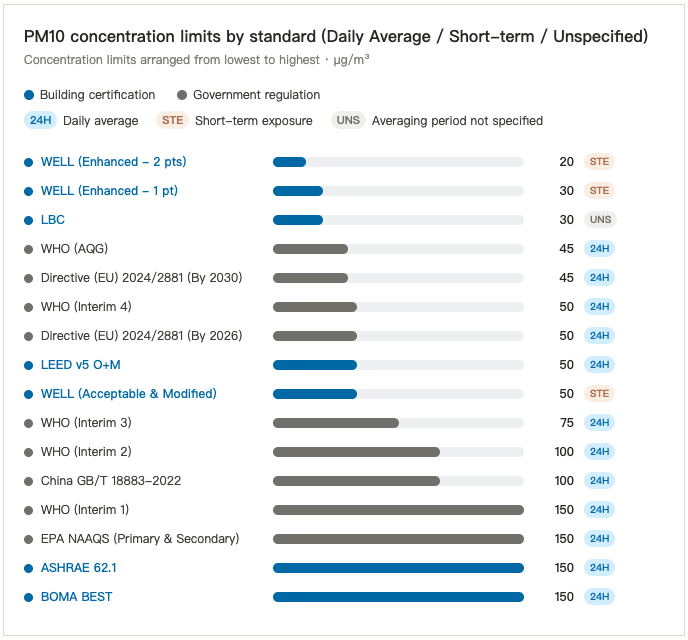
PM10 (Daily & Short-term & Unspecified)
Summary
Range: 20 to 150 µg/m³, a 7.5-fold gap, across 16 limits.
Strictest: WELL Enhanced (2 pts) at 20 µg/m³.
Most common value: 50 µg/m³, where five standards converge: WHO Interim 4 (24H), Directive (EU) 2024/2881 By 2026 (24H), LEED v5 O+M (24H), and WELL v2 Acceptable & Modified (STE).
WHO alignment point: WHO AQG at 45 µg/m³ (24H, Government) aligns with Directive (EU) 2024/2881 By 2030, showing EU alignment with WHO.
Mid-range progression: Steps through 45 µg/m³ (WHO AQG / EU 2030), 50 µg/m³ cluster, then WHO Interim 3 at 75 µg/m³ (24H).
Upper end: WHO Interim 2 and China GB/T 18883-2022 at 100 µg/m³ (24H), WHO Interim 1 and EPA NAAQS at 150 µg/m³ (24H), and BOMA BEST at 150 µg/m³ (24H).
Type split: Certifications dominate the low end (20-30 µg/m³), Government standards define the progression from 45 to 150 µg/m³, with LEED v5 O+M included at 50 µg/m³ (24H).
| Standard | Limit | Averaging | Type |
|---|---|---|---|
| WELL v2 (Enhanced - 2 pts) | 20 µg/m³ | STE | Certification |
| WELL v2 (Enhanced - 1 pts) | 30 µg/m³ | STE | Certification |
| LBC | 30 µg/m³ | UNS | Certification |
| WHO (AQG) | 45 µg/m³ | 24H | Government |
| Directive (EU) 2024/2881 (By 2030) | 45 µg/m³ | 24H | Government |
| WHO (Interim 4) | 50 µg/m³ | 24H | Government |
| Directive (EU) 2024/2881 (By 2026) | 50 µg/m³ | 24H | Government |
| LEED v5 O+M | 50 µg/m³ | 24H | Certification |
| WELL (Acceptable & Modified) | 50 µg/m³ | STE | Certification |
| WHO (Interim 3) | 75 µg/m³ | 24H | Government |
| WHO (Interim 2) | 100 µg/m³ | 24H | Government |
| China GB/T 18883-2022 | 100 µg/m³ | 24H | Government |
| WHO (Interim 1) | 150 µg/m³ | 24H | Government |
| EPA NAAQS (Primary & Secondary) | 150 µg/m³ | 24H | Government |
| ASHRAE 62.1 (2022) | 150 µg/m³ | 24H | Certification |
| BOMA BEST | 150 µg/m³ | 24H | Certification |
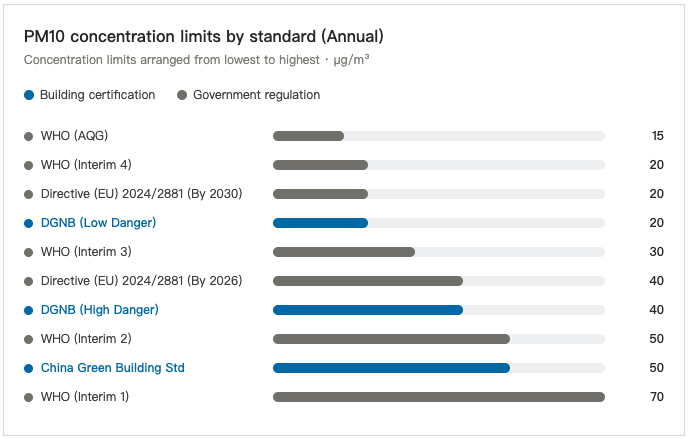
PM10 (Annual)
Summary
Range: 15 to 70 µg/m³, a 4.7-fold gap, across 10 limits.
Strictest: WHO AQG at 15 µg/m³ (Annual, Government).
Most common value: 20 µg/m³, where three standards converge: WHO Interim 4 (Annual, Government), Directive (EU) 2024/2881 By 2030 (Annual, Government), and DGNB Low Danger (Annual, Certification).
Mid-range progression: Steps through WHO Interim 3 at 30 µg/m³ (Annual), then Directive (EU) 2024/2881 By 2026 and DGNB High Danger at 40 µg/m³ (Annual), and WHO Interim 2 / China Green Building Std at 50 µg/m³ (Annual).
Upper end: WHO Interim 1 at 70 µg/m³ (Annual, Government).
Type split: Government standards define the full WHO interim ladder (15 to 70 µg/m³) and EU targets, Certifications mark low-danger and high-danger thresholds at 20 and 40 µg/m³ (DGNB) and 50 µg/m³ (China Green Building Std).
| Standard | Limit | Averaging | Type |
|---|---|---|---|
| WHO (AQG) | 15 µg/m³ | Annual | Government |
| WHO (Interim 4) | 20 µg/m³ | Annual | Government |
| Directive (EU) 2024/2881 (By 2030) | 20 µg/m³ | Annual | Government |
| DGNB (Low Danger) | 20 µg/m³ | Annual | Certification |
| WHO (Interim 3) | 30 µg/m³ | Annual | Government |
| Directive (EU) 2024/2881 (By 2026) | 40 µg/m³ | Annual | Government |
| DGNB (High Danger) | 40 µg/m³ | Annual | Certification |
| WHO (Interim 2) | 50 µg/m³ | Annual | Government |
| China Green Building Std | 50 µg/m³ | Annual | Certification |
| WHO (Interim 1) | 70 µg/m³ | Annual | Government |
Conclusion: What PM Targets Tell Us
PM2.5 and PM10 reveal a clear split between aspirational and regulatory air quality:
Certifications drive stringency: The lowest limits typically come from building certifications instead of governments.
Averaging matters: There are differences between, Short (short term peaks), Daily (daily operation) and Annual (chronic exposure) numbers, which makes assigning averaging times really important. Targets should always have an averaging time and not remain unspecified (UNS). An example is LBC, who specifies concentration limits, but does not define an averaging period. They resolve it by stating that projects may alternatively demonstrate compliance through an ILFI-approved continuous IAQ monitoring standard, such as RESET Air, where the standard’s assessment methodology includes the averaging period.
Additional Compliance Rules: RESET and WELL have an additional compliance rule set used for evaluating continuous monitoring performance, requiring at least 90% of measurements, during occupancy hours, to be within the target threshold. The difference is that RESET uses a daily average while WELL uses a short term average not exceeding 15 minutes. The additional compliance rules allows for irregularities with the consideration that indoor air quality is not 100% controllable and can be easily impacted by many factors.
Unified Targets: Based on the targets, an optimal design is for a PM2.5 Target of 12 µg/m³ (Daily) and 9-10 µg/m³ (Annual). For PM10 targets, 45 µg/m³ (Daily) and 20 µg/m³ (Annual). With these targets, a project can satisfy 5+ certifications and sit within striking distance of WHO AQG.
In Part 2, we apply this same lens to CO2 + CO.
Appendix: Standards List and Resources for Particulate Matter
Government standards, codes, and guidelines (5 total):
World Health Organization (WHO). WHO Global Air Quality Guidelines: Executive Summary. p. 4.
US EPA NAAQS — National Ambient Air Quality Standards: NAAQS Table
EU Directive 2024/2881: EU Directive 2024/2881, Annex I
Singapore SS 554 (2021) : SS 554:2016+A1:2021 Code of Practice for Indoor Air Quality for Air-Conditioned Buildings. p. 20.
China GB/T 18883-2022: GB/T 18883-2022 室内空气质量标准. p. 3.
Building certifications and private frameworks (10 total):
RESET Air v2.0: RESET Air Standard.
LEED v5 O+M: LEED v5 Reference Guide for Building Operations and Maintenance. November 2025 Edition, pp. 67–68.
WELL v2: The WELL Building Standard v2.
Fitwel: Fitwel v3 Indoor Air Quality Assessment Protocol. p. 13.
Living Building Challenge (LBC): Living Building Challenge 4.1 Program Manual. January
ASHRAE 62.1 (2022): ANSI/ASHRAE Standard 62.1-2022: Ventilation for Acceptable Indoor Air Quality. 2022, p. 1.
DGNB: DGNB System – Buildings In Use, Criteria Set Version 2026. 2026, pp. 98–99.
BOMA BEST: BOMA BEST Field Guide.
Singapore Green Mark: SS 554:2016+A1:2021 Code of Practice for Indoor Air Quality for Air-Conditioned Buildings. p. 20.
China Green Building Standard: 《绿色建筑评价标准》. 2024, p. 6.
